HomeFAQ
Cheektowaga & Western New York

Questions about your home's electrical?

What does a panel upgrade actually cost? Do you need a permit? Is that Federal Pacific panel really a fire risk? Straight answers here, in plain words, with real Western New York numbers and no runaround. If you don't see your question, ask us and we'll tell you straight.

Want us to come take a look? (716) 510-4227
Licensed & insured
The quote is the price
Free look at your panel

Still have a question?

Tell us what's going on. We'll get back to you fast with a straight answer and an honest price.

The questions Cheektowaga homeowners actually ask us.

Most homes around here were built before 1990, and many before 1970, wired for a fraction of what a house runs today. Nearly every question below comes back to that one fact: an older house now carrying modern loads. Jump to what you need.

Costs & pricing

Real Western New York ranges, labeled as estimates. Northeast pricing runs well above the national low end, so these are anchored to the Buffalo and Cheektowaga market. Your exact number is the locked quote you approve before work starts.
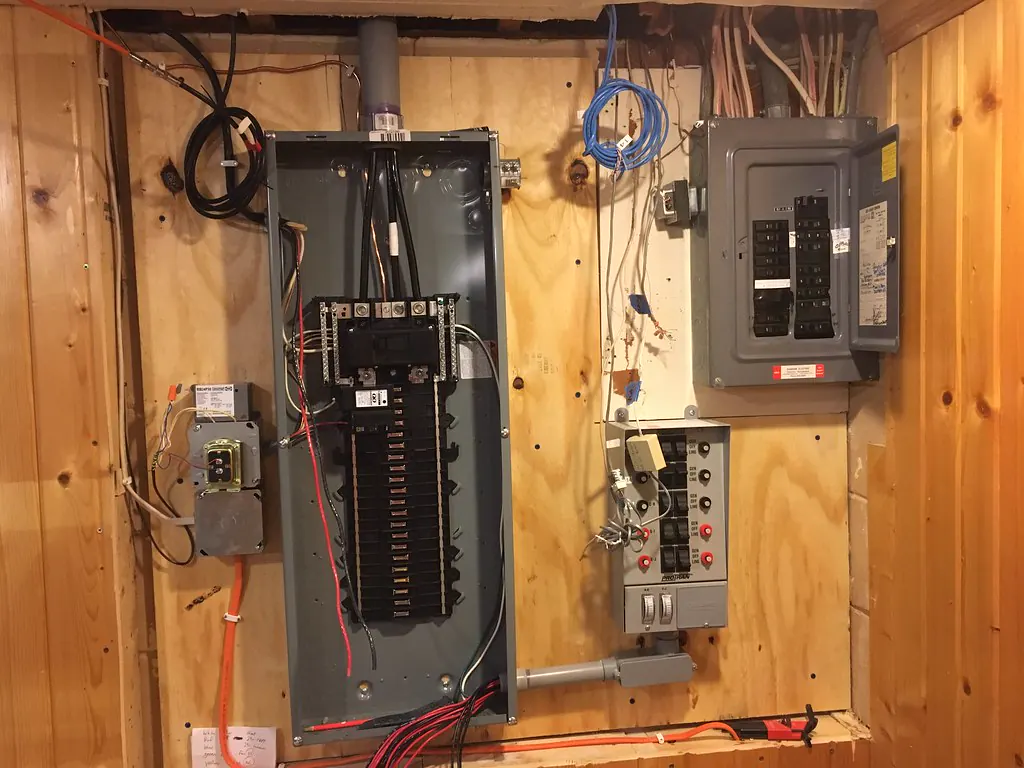
A new 200-amp breaker panel installed next to an older full 100-amp panel
A new 200-amp panel beside the old 100-amp one it replaced. The panel tells us most of the price up front, and the quote is the price. Photo: davef3138, CC BY 2.0
How much does an electrical panel upgrade cost in Cheektowaga?

A straightforward 100 to 200 amp panel and service swap in the Cheektowaga and Buffalo area runs about $2,000 to $3,500 as an estimate. If the job also needs a new meter, mast, or service entrance brought up to current code, it commonly runs $3,500 to $5,800 or more.

What moves the number is your current amperage, whether the service entrance and meter get replaced, the required outdoor disconnect, and where the panel sits. See the full breakdown on our panel upgrade cost page, or the process on the panel upgrade page. Every figure here is an estimate. Your price is locked in writing before we start.

How much does it cost to replace a Federal Pacific or Zinsco panel?

Replacing a Federal Pacific or Zinsco panel on its own runs about $2,000 to $4,500 as an estimate. Because these panels sit in homes built before the 1990s, the job often travels with other work. When it is done as a full 200 amp service upgrade, which is the usual case in older homes, a combined job runs about $5,500 to $7,000 or more. Zinsco is not more expensive than Federal Pacific to replace.

One thing to know up front: insurance does not pay for this. Carriers treat a panel swap as maintenance, not a covered loss, so the cost falls on you. Full details on our Federal Pacific and Zinsco page.

How much does it cost to rewire a house in Western New York?

A whole-house rewire or knob-and-tube removal on an older WNY home runs about $12,000 to $36,000 as an estimate, which works out to roughly $8 to $17 per square foot. A small or partial rewire costs less than the whole-house number.

The biggest local price driver is plaster-and-lath walls, common in older Cheektowaga homes, which add roughly 25 to 30 percent because plaster is much harder to fish than drywall. A second story adds labor too. More detail lives on our whole-house rewiring page.

How much does a Level 2 EV charger install cost here?

A Level 2 home EV charger install in the Buffalo and Cheektowaga area runs about $1,200 to $3,000 as an estimate for a straightforward job. A long wire run, a detached garage, or a panel that has to be upgraded first can push it to $4,000 or more. A Tesla Wall Connector specifically runs about $1,400 to $3,200 installed.

The federal EV charger tax credit expired June 30, 2026, so we do not count it in your numbers. See the EV charger cost page or the EV charger installation page.

How much does a whole-house standby generator cost installed?

A whole-house standby generator installed in WNY runs about $8,000 to $16,000 as an estimate. That includes the generator, the automatic transfer switch, the gas line connection, the pad, permits, and labor.

A long gas run or a panel that has to be upgraded first can push it toward $18,000 to $20,000. The main driver is the distance from your gas meter and panel to where the unit sits. More on our generator installation page.

Why are these prices higher than the national numbers I see online?

Most national cost-guide sites average in cheaper Southern and Midwestern markets, and they show a bare panel swap. Northeast labor and overhead run higher, and a real service upgrade in New York includes work those numbers leave out.

On top of that, older Cheektowaga homes carry real cost drivers a generic guide ignores: plaster-and-lath walls, an original service mast, grounding that has to be brought up to code, and an outdoor emergency disconnect the current code requires on a service upgrade. A range anchored to this market is honest. A national low-ball that becomes $2,400 at the end is exactly what the Price-Lock Guarantee exists to prevent.

Can I finance a panel upgrade or rewire?

We don't offer financing right now. What we can do is give you a straight price and never move it on you. The number in your written quote is the number you pay, even if we run into something in the wall. That is the Quote Is The Price.

On a big job like a rewire, there is often a smart way to stage the work so you handle the most urgent part first. Tell us your situation when we come out and we will tell you honestly what has to happen now and what can wait.
About these numbers: every dollar figure on this page is a realistic 2026 Western New York estimate range, not a quote. Real prices depend on your home, your existing wiring, and what an in-person look finds. Your exact price is locked in writing before any work begins. That is the Price-Lock Guarantee.

Federal Pacific or Zinsco panel?

These panels are a documented fire hazard because the breaker does not always trip, and many insurers will not cover a home that still has one. If your home was built before the 1990s, it is worth a look. We pull the cover and tell you straight whether it needs to go, no charge and no pressure.

See the fix

Panels, wiring & safety

The high-stakes questions. Old panels, insurance, and the symptoms that mean call now. If you see smoke or flames or a wall is hot, get out and call 911 first.

Are Federal Pacific and Zinsco panels really dangerous?

Yes, and it is a documented problem, not a sales pitch. On these panels the breaker is supposed to shut the power off when a circuit overloads, and it does not always do it. Federal Pacific Stab-Lok breakers are known to fail to trip, and Zinsco breakers can fuse to the bus bar so the breaker reads on but no longer protects the circuit. In both cases the breaker looks fine and does nothing when it matters. That is how an electrical fire starts.

These panels were never officially recalled. The federal safety commission opened an investigation and closed it in the 1980s without a recall and without a formal safety finding. But the failure history is well documented, and it is why a growing number of insurers refuse to write or renew policies on homes that still have them. Read the full safety and identification breakdown on our Federal Pacific and Zinsco page.

How do I know if I have a Federal Pacific or Zinsco panel?

Open the small panel door and look for the name. Federal Pacific panels usually say FPE or Federal Pacific on the label, with breakers branded Stab-Lok, and many have a red strip across the breaker handles. Zinsco panels, sometimes branded GTE-Sylvania or Sylvania, tend to have breakers with colored handles.

If your home was built before the 1990s, it is worth a look. You don't have to figure this out yourself. Take a photo of the inside of the panel door and send it with your message, or we pull the cover and tell you which one you've got in a couple of minutes. No charge, no pressure. See the Federal Pacific and Zinsco page.

Will my insurance drop me for a Federal Pacific or Zinsco panel or knob-and-tube wiring?

It happens regularly around here. Many carriers will not write or renew coverage on homes with Federal Pacific or Zinsco panels, knob-and-tube wiring, or old aluminum branch wiring, and New York non-renewal letters commonly give you 45 to 60 days before the policy ends.

Insurance treats the fix as maintenance, so it will not pay for the replacement. The cost is yours. If you are holding a letter with a deadline, the move is to get a quote and pull a permit fast. We move quickly on these, and we write up exactly what your insurance company needs to see. More on the panel page and the rewiring page.

My breakers trip whenever the microwave and AC run together. What's wrong?

That is one of the most common calls we get, and it is the classic sign of a panel and service sized for an older, smaller home. Most homes in Cheektowaga were built before 1990, and many before 1970, originally wired for a few lamps and a radio. A 60 or 100 amp panel simply cannot run central AC, a microwave, and everything else at once.

A breaker that keeps tripping is the system protecting itself, so do not just swap in a bigger breaker. That defeats the safety device. The real fix is usually a service upgrade to 200 amps, and we start with a load calculation so you only upgrade if you actually need it.

Is a burning smell or a hot outlet an emergency?

Treat it seriously. If you smell burning or a hot-plastic odor from an outlet or the panel, or an outlet or breaker is hot to the touch, shut off that circuit or the main breaker and call a licensed electrician right away.

If you see smoke or flames, or a wall is hot, get everyone out and call 911 first, then call an electrician. Do not keep using a circuit that smells like it is burning. Buzzing behind the wall, scorch marks around an outlet, and repeated tripping are all handle-it-now signs, not wait-and-see.

How do I know if I have knob-and-tube or aluminum wiring?

Knob-and-tube: in an unfinished basement or attic you will see individual wires running through white ceramic knobs and tubes, with no ground wire and often cloth insulation. It is common in older Cheektowaga homes. It can legally stay if it is undisturbed, but any new circuit has to use a current wiring method, and insurers ask about it.

Aluminum branch wiring shows up in some homes wired in the mid 1960s to mid 1970s and is often stamped AL on the cable jacket. It is a known fire risk at the connections. Both are worth a look. If you're not sure what you have, we tell you straight when we come out. More on our rewiring page.

Do I really need 200 amp service, or is 100 amps enough?

100 amp service is fine for a smaller home with gas heat and modest loads. You typically want 200 amps if you have or plan electric heat, central air, an EV charger, a hot tub, an electric range, or a finished basement, or if your existing panel is already full with no room to add circuits.

Here's the honest part: you may not need 200 amps. We start with a load calculation, so you only upgrade if you actually need the capacity. If 100 amps is safe and enough for you, that's what we'll say. When an upgrade does make sense, it also lets us add the surge, arc-fault, and ground-fault protection the current code requires. See the panel upgrade page.

Permits & inspections in Cheektowaga

This is the part most out-of-town lead mills get wrong. Here is exactly how permitting and inspection work in the Town of Cheektowaga, and how National Grid fits in on a service upgrade.

Do I need a permit for electrical work in Cheektowaga?

Yes. A panel upgrade, service upgrade, rewire, or any new circuit, outlet, or switch that did not exist before needs an electrical permit from the Town of Cheektowaga Building Department at 275 Alexander Avenue, open weekdays 9:00am to 4:30pm, and the finished work has to pass a third-party electrical inspection.

Only a licensed electrician can pull the permit for you. A homeowner may pull their own, but it still needs the third-party inspection. We pull the permit and schedule the inspection for you as part of the job, not an extra you chase down. An electrician who offers to skip the permit to save a few dollars is a red flag, because unpermitted work can surface later at resale or on a claim.

Who inspects electrical work in Cheektowaga?

In Cheektowaga a New York State approved third-party inspection agency that the town accepts does the electrical inspection, not a town employee. This surprises a lot of homeowners.

A town permit number has to be issued before the inspection happens. When the work passes, the inspector leaves a dated tag right at your panel and files the certificate with the Building Department. On a service upgrade, National Grid will not make the permanent connection until the inspection is done. You never touch the paperwork. We handle it.

Who pulls the permit, me or the electrician?

We do. Pulling the Town of Cheektowaga electrical permit, coordinating with National Grid for the meter, and scheduling the required inspection are all on us. You do not need to visit 275 Alexander Avenue or fill out town forms yourself.

Handling the permit and inspection is exactly what separates a real local electrician from a fly-by-night operator, and it is baked into every quote we give, not tacked on afterward.

How does the National Grid disconnect and reconnect work on a service upgrade?

National Grid is the WNY electric utility, and for a panel or service upgrade they coordinate the meter disconnect and reconnect. The sequence is: pull the permit and coordinate the disconnect with National Grid, swap the panel and service entrance, have the approved agency inspect and issue the certificate, then National Grid makes the permanent connection and reseals the meter.

The actual disconnect is often a short, scheduled interruption, not an all-day outage. We manage this whole hand-off so you do not have to.

How much does the permit cost, and is it in my quote?

A Town of Cheektowaga electrical permit typically runs on the order of $100 to $300 depending on the scope of the job. It is a real line item, and we fold it into the written quote so it is part of your locked-in price, not a surprise on the final bill.

Because it is covered by the Price-Lock Guarantee, the permit and inspection cost is settled before we start. No "the town charged more than expected" add-on after the fact.

What does New York code require when I upgrade my panel?

New York follows the 2023 National Electrical Code for permits filed here now. In practice, a panel or service upgrade brings a few safety items with it: an outdoor emergency disconnect at the service so firefighters can cut power fast, whole-house surge protection, and arc-fault and ground-fault protection on the branch circuits that need it.

You are not paying extra for luxuries. You are getting current code safety built into the job, which is also what lets it pass inspection. It is a big reason older 60 and 100 amp Cheektowaga panels get upgraded. They physically cannot accept modern breakers or handle the loads the code now assumes. See the panel upgrade page.

Timing, power & your walls

The practical "how will this affect my week" questions. How long the power is off, how long the job takes, and what happens to your drywall.

How long will my power be off during a panel upgrade?

On install day your power is usually off for part of the day, often four to eight hours, while the old panel comes out and the new one goes in. It is the single biggest unspoken worry homeowners have, so we tell you the window up front and plan around your day where we can.

Most straightforward panel and service upgrades are done in one working day, not weeks. National Grid handles the meter disconnect and reconnect, and that utility step is often a short, scheduled interruption rather than the full outage. You can stay home the whole time.

How fast can you start, and how long do jobs take?

Reach out and we'll tell you the soonest we can get to you. Rough timelines: a panel or service upgrade is typically a one-day job, an EV charger is often a few hours, and a generator install is usually one to two days once the unit is on site.

A whole-house rewire is the big one. Usually about one to three weeks depending on the home's size, wall access, and whether the panel is upgraded at the same time. You get a realistic timeline with your locked-in quote, not a vague "we'll see."

Will you cut open my walls, and who fixes the drywall?

For a panel or service upgrade, usually no wall damage at all. For a rewire, we fish new wire through walls, ceilings, the attic, and the basement wherever we can and keep the cuts to a minimum, but some openings are unavoidable to reach old wiring, especially behind the plaster and lath common in older Cheektowaga homes.

Here is the honest part. We tell you exactly what will be opened before we start, and we either patch the openings or coordinate the drywall so you are never surprised by the condition we leave the walls in.

Can I stay in my house while you rewire it?

In most cases, yes. A rewire is done in stages, room by room, and the power is shut off room by room, not for weeks, so the home stays livable. You are not without electricity for the whole project. We walk you through which areas are affected on which days.

For a very large or fully gutted job, there may be short stretches where certain rooms are offline. We plan that with you in advance so it fits your life, not the other way around. More on the rewiring page.

Do you clean up and haul away the old panel and wiring?

Yes. We remove the old panel, breakers, and any wiring we pull out, and we leave the work area clean. Hauling away what we replaced is part of the job. You are not left with an old panel on the basement wall or a pile of scrap wire in the yard.

Licensing, trust & the Price-Lock Guarantee

The "can I trust this person" questions every homeowner should ask any electrician, and exactly how we answer them.

Is Cheektowaga Electrical licensed and insured?

Yes. Here is the honest nuance: New York does not issue a statewide electrician license. Licensing here is handled locally, so any honest electrician in this area is licensed through the municipalities that require it, not through the state. We are licensed and insured to do this work, we pull the required town permit, and every job gets a third-party inspection.

Ask any electrician, us included, for proof of their license and a certificate of insurance. A legitimate pro hands them over without hesitation. If you want to see ours before we start, just ask. We would rather you feel sure.

What exactly is the Price-Lock Guarantee?

The quote is the price. You approve the number before anything happens, and you never pay for work you didn't sign off on. If we run into something inside the wall that changes the scope, we stop and check with you first, and you decide before any extra work or cost happens.

It exists because the number one complaint in this trade is an $800 estimate that becomes $2,400. That surprise-bill move is exactly what we refuse to make.

Will the person who quotes the job be the one doing the work?

Yes. You get a real licensed electrician on your job, not a commissioned salesperson who quotes high and hands the work to whoever is cheapest. The person assessing your panel is the person accountable for the work and the locked-in price.

That continuity is the whole point of hiring a focused local electrician instead of a national lead mill. One accountable person from quote to inspection tag.

Do you take a big cash deposit up front?

No. We do not demand a large cash deposit before work begins, and you should be cautious with any contractor who does. A real, licensed electrician does not need most of the money before the job is done.

You get an itemized written quote first, and the Price-Lock Guarantee means that number is what you pay. A big upfront cash demand is one of the classic warning signs of a bad actor.

Is the estimate itemized and in writing?

Yes. You get a written, itemized quote, not a number scribbled on the back of a business card. It spells out the work, the materials, and the permit, so you can see exactly what you are paying for.

An itemized written quote is also what makes the Price-Lock Guarantee meaningful. You cannot lock a price you cannot see. Vague verbal-only estimates are how the $800 becomes $2,400 surprise happens.

How do I verify an electrician is actually licensed in New York?

Because licensing is local, ask directly for two things: proof of the municipal electrical license for the area your home is in, and a current certificate of insurance. Reputable electricians provide both on request without pushback.

You can also confirm they will pull a town permit and use a third-party inspector. A contractor who wants to skip permitting is a contractor to skip. Being able to walk you through all of this is itself a sign you are dealing with a genuine local pro.

Specific services

EV chargers, generators, rewires, and the WNY-specific questions that come with them. Want the full write-up? Each answer links to its dedicated page.

Do I need to upgrade my panel to install an EV charger?

Sometimes, not always. If your home already has a 200 amp panel with room to spare, you usually do not need an upgrade. If you are on an older 100 amp panel that is already loaded with the furnace, AC, water heater, and everything else, adding a charger can push it past its safe limit, and a service upgrade comes first.

A load calculation, and sometimes a load-management device, tells us which situation you are in and can sometimes avoid a full upgrade. It takes us a couple of minutes to check your panel capacity. The full walkthrough is on the EV charger installation page, and if you do need the upgrade, the numbers are on the panel upgrade page.

Is there a tax credit or rebate for a home EV charger in NY?

There is no upfront state or utility rebate that covers the cost of installing a home charger. The federal EV charger tax credit expired June 30, 2026, so we do not count it in your numbers.

If you are already a National Grid customer, the Charge Smart NY program pays an ongoing off-peak bill credit for charging overnight, but that is a usage credit on your bill, not money toward the install. Programs change, so we tell you what is actually available the day we quote your job. Details on the EV charger cost page.

Should I hardwire the EV charger or use a plug-in outlet?

For a permanent home charger we usually recommend hardwiring it. It is more reliable at the continuous high load an EV pulls. A big-box plug-in outlet, the kind used for a range, is rated for short bursts, not for hours of steady charging every night, and cheaper ones can overheat under that load.

A hardwired charger on a properly sized breaker avoids that. If you want the flexibility of a plug, we will size and install the outlet correctly. Either way it gets done to code and needs a permit. See the EV charger page.

Is a whole-house standby generator worth it in Western New York?

For a lot of homes here, yes, and the reason is the basement and the furnace, not just the lights. When the power goes out around here it is usually the worst time, an ice storm or a blizzard like December 2022, when more than 100,000 homes in the region lost power for days and 11 people in Erie County died in their own homes without heat.

A standby generator with an automatic transfer switch kicks on by itself, even when you are not home, and runs your furnace, sump pump, and fridge. On natural gas you never run out of fuel during a multi-day outage. See the generator installation page for sizing and cost.

Will a generator run my furnace and sump pump automatically?

Yes. That is the point of a standby unit rather than a portable one. It is wired to an automatic transfer switch that senses when National Grid power drops and starts the generator within seconds, with no cords to drag out and no manual switching. When utility power returns, it switches back and shuts the generator down.

A whole-home switch covers everything. A managed or essential-circuits switch covers the critical loads, heat, sump, and fridge, at a lower cost. We size it to what actually matters in your home. More on the generator page.

What size generator do I need for my house?

For most Western New York homes with central air, an 18 to 22kW standby generator covers the whole house. The right size depends on what you want to run at once and whether your home is all-electric. We'll come look at your setup and tell you straight what size your house actually needs, not the biggest unit on the shelf.

An all-electric home with electric heat and a heat pump needs more capacity than a home with a gas furnace, and an older 100 amp panel may need upgrading to support it. When we come out we look at your actual loads and size it so it runs what matters without paying for more generator than you need. See the generator page.

Does homeowners insurance cover a panel replacement or rewire?

No. Insurance treats replacing an old panel or old wiring as maintenance, not a covered loss, so it will not pay for the work. The cost falls on you.

What replacing it does do is keep your policy, because a modern panel and current wiring are exactly what the carrier wants to see. If you have a non-renewal letter with a deadline, doing the work is what lets you keep coverage. See the panel page.

Which towns do you serve besides Cheektowaga?

We serve Cheektowaga plus Buffalo, Amherst, Tonawanda, West Seneca, Depew, Lancaster, Williamsville, Orchard Park, Sloan, Hamburg, and Kenmore, essentially the 716 across Erie County.

Permit and inspection specifics vary by town, and we handle the correct local process for wherever your home is. See the full list on our service areas page.

Don't see your question? Ask it straight. Call (716) 510-4227 or use the form below. You get a real answer from a licensed electrician, not a script.

The Quote Is The Price

You approve the number before anything happens, and you never pay for work you didn't sign off on. If we run into something inside the wall, we stop and check with you first. No surprise bills.

Ready for the details?

Every service has its own deep page with real WNY pricing, the local permit process, and an FAQ of its own.

See the towns we serve →

Want us to come take a look?

Tell us what's going on with your electrical. We'll get back to you fast with a straight answer and an honest price. No pressure.

Licensed & insured Free quotes Cheektowaga & WNY only
Call (716) 510-4227 for a Free Quote